Apple skips September: M6, 512 GB Macs and the local AI obsession
The August surprise
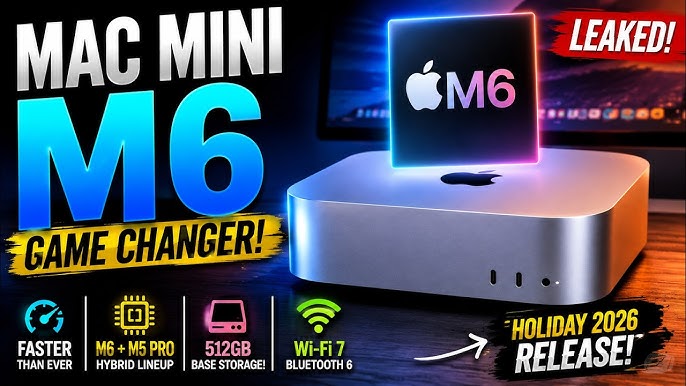
Apple doesn't do August launches. It does September keynotes, on schedule, with the whole industry watching. This year it broke its own calendar. On August 25, 2026, the company revealed the M6 chip, a new Mac mini and a new Mac Studio. No keynote. No buildup.
The M6 is etched in 2 nm and carries a double Neural Engine that Apple says is twice as fast as the previous generation. Each graphics core gets a Neural Accelerator. Apple claims up to 4 times more AI performance on the Mac mini M6 than on the M4-powered model.
Omar Belkaab, editor-in-chief at Frandroid, spotted the pattern in every announcement. Apple's pitch for the new Mac mini: "a considerable leap forward in AI performance, which energizes the leader of the desktop computer market for continuous agentic computing." That's a lot of words for a simple idea. Apple wants LLMs running on the machine, not in a distant data center.
Local AI is the whole point
The Mac Studio takes it further. Up to 512 GB of unified memory means you can load models with several hundred billion parameters on a machine that sits on a desk. For anyone building AI for a living, that changes what a workstation is.
The Mac Studio pushes the logic far: 512 GB of unified memory, enough to load models of several hundred billion parameters on a single machine on a desk.
The competition is real
Apple is not alone on this turf. Nvidia and Dell shipped the DGX Spark with 128 GB of unified memory. Microsoft has a mini Surface that runs 120 billion parameter models. Minisforum is attacking the Mac mini head-on. Xiaomi has an AI Cube with its own chip. On memory, the Mac Studio keeps a clear lead.
The M5 Ultra is the quiet monster
The M5 Ultra, presented as the most powerful chip Apple has ever designed, glues four chips into one, a first for the company. Apple claims up to 4.3 times the AI computing power of the M3 Ultra. You can even link Mac Studios together: four coupled machines deliver up to 3 times the AI inference of a single unit, according to Apple.
One caveat: part of the experience depends on macOS 27 and the new Siri, still in beta, expected this fall. Benchmarks will tell whether the promises hold. Until then, the hardware story is clear. Apple bet its desktop lineup on local AI, and it shipped before its own September keynote to say so.